
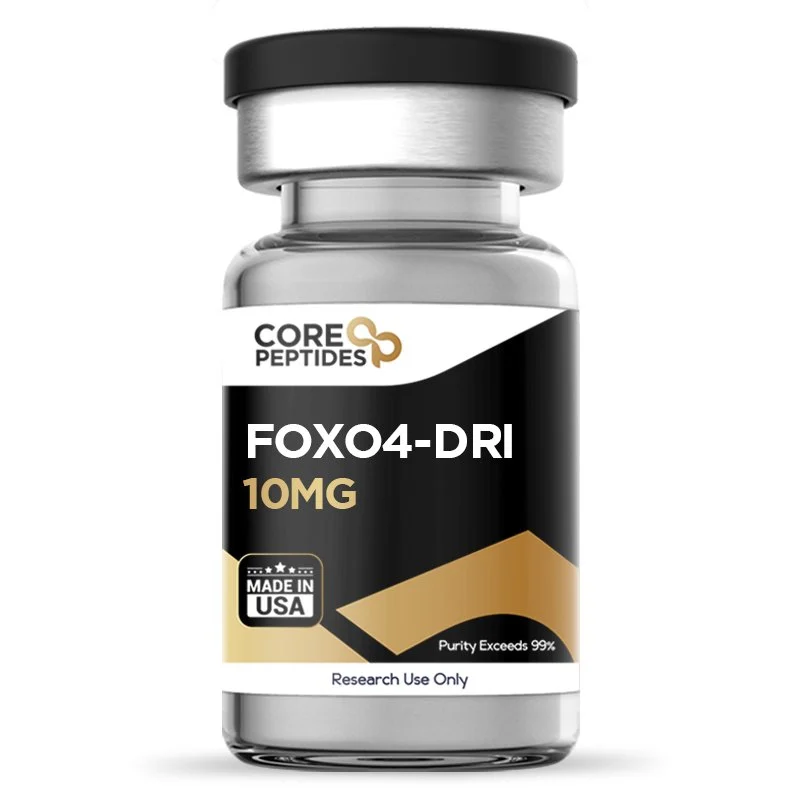
FOXO4-DRI Peptide (FOX04) — Research Grade Senolytic Compound
99%+ Purity | Lyophilized Powder | Certificate of Analysis Included
Product Overview
FOXO4-DRI (also known as FOX04 peptide or FOXO4 D-Retro-Inverso peptide) is a synthetic, cell-permeable research peptide designed to selectively disrupt the interaction between the FOXO4 transcription factor and the p53 protein in senescent cells. Developed for use in controlled laboratory settings, FOXO4 is one of the most studied senolytic peptides in modern aging and cellular biology research.
What Is FOXO4-DRI?
FOXO4-DRI is a cell-penetrating peptide (CPP) engineered to selectively target senescent cells. The “DRI” designation refers to the D-Retro-Inverso modification — a reversal of D-amino acid sequences that increases the peptide’s potency and resistance to enzymatic degradation.
FOXO4 Peptide acts as a peptide antagonist designed to disrupt the protein-protein interaction between FOXO4 and p53. In multiple experimental systems, FOXO4 has been described as supporting the viability of senescent cells, in part by influencing p53 localization and apoptotic restraint mechanisms.
Mechanism of Action
FOXO4 protects senescent cell viability by keeping p53 sequestered in nuclear bodies, preventing it from inducing apoptosis. Disrupting this interaction with the all-D amino acid peptide FOXO4-DRI restores p53’s apoptotic role and ameliorates the consequences of senescence-associated loss of tissue homeostasis.
In simpler terms: blocking FOXO4, which inhibits the activation of p53, causes senescent cells to undergo apoptosis by p53 activation, without affecting healthy cells around them.
Key Research Applications
- Cellular Senescence Studies — Investigating the selective removal of senescent cells in various tissue models
- Aging & Longevity Research — In preclinical mouse studies, FOXO4-DRI treatment led to recovery of fur in fast-aging mice within 10 days, improved fitness markers within three weeks, and indicators of healthy kidney function within a month of treatment
- Chondrocyte & Cartilage Research — FOXO4-DRI has been studied for its capacity to selectively remove senescent cells from in vitro expanded human chondrocytes, with researchers hypothesizing it could enhance their potential to generate high-quality cartilage
- Male Reproductive Biology — Research has explored FOXO4-DRI’s potential to alleviate age-related testosterone secretion insufficiency by targeting senescent Leydig cells, improving the testicular microenvironment in aged animal models
- Chemotoxicity Models — In vivo studies showed FOXO4-DRI reversed doxorubicin-induced chemotoxicity markers, including increased body weight and reduced levels of liver damage indicators
Product Specifications
| Property | Details |
|---|---|
| Peptide Name | FOXO4-DRI (FOX04 Peptide) |
| Also Known As | FOXO4 D-Retro-Inverso, Senolytic Peptide FOX04 |
| Purity | ≥99% |
| Form | Lyophilized (freeze-dried) powder |
| Storage | Cool, dry place, away from direct light |
| Quality Standard | Pharmaceutical-grade with batch verification |
| Documentation | Certificate of Analysis (CoA) included |
Why Researchers Choose FOXO4-DRI
- ✅ High selectivity — targets senescent cells while leaving healthy cells unaffected
- ✅ Consistent composition — pharmaceutical-grade purity supports repeatable experimental outcomes
- ✅ Stable format — lyophilized powder maintains integrity during storage and transport
- ✅ Well-documented — backed by published research in peer-reviewed journals including Cell, Frontiers in Bioengineering and Biotechnology, and Cancer Discovery
Important Notice
For Research Use Only. FOXO4-DRI peptide is intended exclusively for in vitro laboratory research applications. It is not approved for human or veterinary use, and is not intended to diagnose, treat, cure, or prevent any disease or medical condition. All studies should be conducted in accordance with applicable institutional and regulatory guidelines.
Order today and receive your Certificate of Analysis with every batch. Suitable for in vitro senescence studies, aging biology, molecular biology, and cellular signaling research.
You can also check out one of our best selling peptide products below..
Retatrutide – ResearchPurePeptides
Reviews
There are no reviews yet.